Ticker: (7832.T). Not financial advice.
Strategy
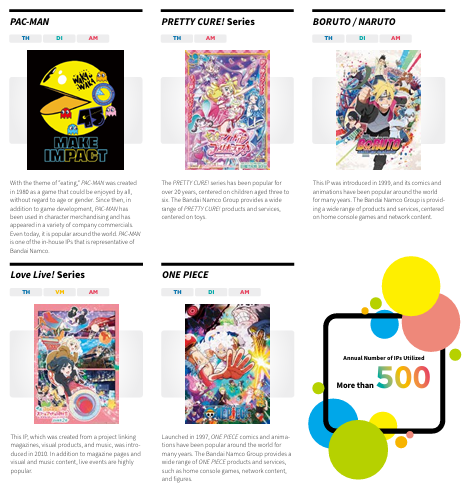
Bandai Namco’s positioning is particularly compelling due to its ability to leverage franchises across games, toys, amusement parks etc. By monetizing IP through multiple formats, the company builds an integrated ecosystem that extends the lifecycle and economic value of each franchise. This structure creates meaningful moats, as success depends not on a single hit product but on coordinated execution across several categories.
The primary risk is competition, particularly from rights holders such as Shueisha, which has stated ambitions to capture more value from its own franchises. However, partners like Shueisha lack the operational capabilities required to replicate Bandai’s model independently, as publishing, game development, and large-scale product commercialization rely on distinct and non-transferable skill sets. While competition remains a structural feature of the entertainment industry, franchise-driven ecosystems provide durability in margins and customer engagement.
Multiples
Bandai Namco is currently trading at a P/E of 24.4, representing a 12.6% discount to its five-year historical average and a 10% discount to peers. This multiple does not reflect first-half results, which indicate a modest increase in earnings. Assuming a long-term earnings CAGR of 10–14%, the implied annual return ranges from 12.7% to 20.2%, based on a 10% discount rate and an exit multiple of 24 under a continuous growth assumption. Over the past ten years, Bandai has delivered a CAGR of approximately 14%
From a balance sheet and profitability perspective, Bandai Namco maintains low leverage and strong margins, broadly in line with peers.
Bandai multiples:
| Liabilities/Assets | 28,01% |
| Income/Liabilities | 42% |
| Income/Revenue | 10,39% |
| Income/Assets | 11,70% |
| Income/Non Current Assets | 32,41% |
Notable mentions:
- Kadokawa may increasingly pursue in-house game publishing rather than relying on Bandai Namco, which could reduce Bandai’s access to third-party IP over time.
- A significant share of Bandai Namco’s IP exposure is tied to the anime segment, making parts of its growth dependent on continued demand within this category.
- The current P/E multiple is partially influenced by the exceptional success of Elden Ring; as expectations normalize and release-related hype fades, reported growth and valuation metrics may compress.
- The japanese yen (as illustrated vs the euro beneath).

What MultipleStrategy thinks
While Bandai Namco currently trades at an attractive valuation with strong profitability, structural risks to its Digital Business are emerging. The company relies heavily on licensing major IPs from media giants like Shueisha and Kadokawa—partners increasingly signaling intent to capture more value in-house.
Signs of this shift are already visible. Kadokawa’s subsidiary, FromSoftware, recently reclaimed sole trademark rights for Elden Ring, indicating potential self-publishing of future blockbusters. Shueisha has launched Shueisha Games to develop indie titles internally, potentially still leaving room for Bandai Namco’s AAA studios.
If these IP holders increasingly bypass Bandai Namco, the Gaming segment—responsible for a substantial portion of high-margin revenue—faces significant pressure. In contrast, the Toys & Hobby division remains protected by a moat of manufacturing and branding competencies, insulating it from similar disruption.
In short, Bandai Namco remains a solid investment if it can maintain market share in its Digital Business, assuming continued global adoption of anime.
***Should mention:
Bandai Namco owns Tekken & Gundam.
– An older but relevant table illustrating margins and market caps across peers:

Note: Square Enix is affected by one time effects.