Tag: Investment Research

  • Assessing cBrain’s Potential in a Competitive Government Software Market

    Assessing cBrain’s Potential in a Competitive Government Software Market

    Everyone can code now – but not everyone has brand reputation, customer relations or the competencies to navigate the bureaucracy – all these key elements might be overlooked and misunderstood at the current valuation.

    cBrain claims to have a total addressable market of 325 billion DKK in the global government software market.

    But; How much of this market is cBrain likely to capture?

    #1 Competitors

    cBrain is not entering empty territory. In the US, UK, or Germany, local equivalents of EG and Systematic already possess the exact same bureaucratic and relational moats that cBrain enjoys in Denmark. In a low churn sector, does this severely impact TAM.

    #2 New Entrants

    If AI allows any localized startup to build bespoke workflow tools rapidly, the frequency of new entrants is mathematically high. However, the consequence of this threat to cBrain is remarkably low. Central governments do not buy critical infrastructure from startups. They demand ISO certifications, heavily audited sovereign cloud compliance, and a decade of referenced reliability. This bureaucracy acts as a moat against disruptive new entrants.

    #3 Need for product development

    cBrain’s products are essentially:

    – F2 paperless – A highly disciplined, standardized digital filing cabinet and routing system

    – F2 climate – The exact same F2 Core engine, but pre configured to process carbon permits, ESG reporting, and green subsidies

    – F2 customization – ServiceBuilder is the low-code toolkit that allows local consulting firms to configure F2 for local governments.

    These products are by no means representative of the whole 325 billion DKK TAM. For cBrain to ever approach this figure, it would require excessive product development into areas outside their core competencies. Because F2 does not replace ERP systems or heavy infrastructure, a more realistic TAM is closer to 10% of their reported figure. To extend beyond this 10%, cBrain cannot rely on a simple copy-paste of their current product into new markets; they would need extensive R&D and a fundamentally different sales reach.

    So; How are cBrain planning to capture this market?

    #1 With aggressive sales in new markets through external companies.

    cBrain is pivoting hard to an “F2-for-Partners” model, where external consultancies can install and implement cBrains F2 products. They are building tools (F2 ServiceBuilder) that allow external stakeholders to configure and implement the software.

    While this should propel potential customers – it might also be a double-edged sword – Giving sales channels to external partners unavoidably gives away control of own sales channels and execution, potentially damaging cBrain’s reputation and customer relations.

    Can cBrain copy paste its Danish government competencies to other governments?

    Most likely no. Expecting a 1:1 frictionless interaction using “the Danish way” in different cultures with different “ways of doing it” – will undoubtedly provide friction across stakeholders. With that said – cBrain already has customers globally; proving their model can be exported.

    The Corporate Sustainability Reporting Directive (CSRD) and the Corporate Sustainability Due Diligence Directive (CSDDD) are currently being implemented. This is an opportunity for cBrain as their F2 climate can give them “a foot in the door”.

    Also, what about incentives and management?

    Per Tejs Knudsen founded cBrain in 2002, took it public in 2006, and remains CEO of cBrain — that’s over 20 years of continuous founder leadership. He holds shares through his personal holding company, Putega Holding ApS. CTO Thomas Qvist is also a co-owner through Felida Holding ApS and has been with the company since 2003. The two co-founders did sell a combined 4.2% stake in 2021 to bring in institutional investors. Per received total annual compensation of roughly 3.2 million DKK as of 2024, with base salary of about 2.2 million making up the majority. For a company with a market cap around 3 billion DKK, that’s remarkably modest.

    This highlights a long-tenured management – with high insider ownership – resulting in high alignment with shareholders. Finally, the board is diverse and consists of expertise within government, IT and law.

    Also, Per Tejs Knudsen has a Master of Science in Engineering from the Technical University of Denmark (DTU) and HD in Accounting from the Copenhagen Business School.

    So is cBrain a good investment?

    Assuming cBrain can capture 20% of my revised TAM. At a 20% income ratio. Are we looking at a 30 times increase in earnings.

    Math stuff

    Revised TAM (product-relevant market):
    10% of 325B = 32.5B DKK
    Addressable share (realistic market capture):
    20% of 32.5B = 6.5B DKK
    Potential income at 20% margin:
    20% of 6.5B = 1.3B DKK
    Earnings multiple: 1.3B / 43M ≈ 30x current earnings

    cBrain currently (date: 05.04.2026) trades at a TTM PE of 30.

    The hurdle of international expansion is massive. Competing with existing national players is not an easy task – But CSRD and CSDDD regulation might boost adoption of the F2 platform. Another potential boost to sales and market share is the adoption of third party consultants. With external partners the scalability significantly increases – at the cost of customer relationship management. Though the incorporation of external partners partly resolves the issue of difference between cultures and workflows – by allowing for customization.

    A PE in the 30s demands strong execution! And headroom for growth. cBrain has both. But can they capitalise and scale in new markets? A patient investor might wait and see – I assume the current skepticism surrounding software companies is overdone – and am willing to take on that risk. This is not a margin of safety play – but an expected value play (asymmetric risk reward).

    Scenario analysis

    Scenario weight 10% = 30 times increase in earnings; exit multiple PE 25. Potential market cap = 32,250M DKK

    Scenario weight 65% = 2 times increase in earnings; exit multiple PE 20. Potential market cap = 1,720M DKK

    Scenario weight 25% = no increase in earnings; exit multiple PE 15. Potential market cap = 645M DKK

    Current market cap = 1,290M DKK

    Weighted annual return = 4,504 / 1,290 = 3.5x or 13% a year – over a 10 year horizon; assuming no discount rate. This is under my normal margin of safety at 20% – with a large upside pulling up the average return, meaning great risk of failure. So why am I still considering investing? It’s plus EV and I trust the management. But, In this case; for a 30PE company, there are simply too many IF’s. The uncertainty regarding the product and competition – makes this bull thesis too fragile. I am looking for high conviction, high growth and conservative pricing. cBrain as an investment thesis, is simply not there yet.

    Notes & Key Issues

    Two conflicting statements from cBrain annual report:

    Note : “cBrain estimates the global addressable market for the F2 digital platform to exceed 50 billion USD” (page 14, cBrain annual report 2025).

    Market analysts estimate the global government software market to exceed USD 50 billion, driven by continued digitalization at national, regional, and local government levels” (page 6, cBrain annual report 2025).

    Based on my analysis – these two statements are contradicting. I have left it for now. TAM are notoriously difficult to assess. For this analysis to truly shine it really needs two things:
    1. Using cBrains TAM assessment is questionable – as I truly don’t know what they estimate as “global government software market. A homemade TAM would significantly improve this analysis.
    2. I would need to know more about the product and how satisfied customers are with it.

    Another thing –

    Financial Overview (DKK millions)

    Financial20222023202420252026E
    Revenue188239268251275–290
    Revenue growth+27%+12%-6%10-15%
    EBT4981865641-58
    EBT margin26%34%32%22%15-20%
    Net income (approx)38636543

    Revenue fell 6% and margins compressed from 32% to 22%. cBrain attributes this to delays in large government projects, and they’re guiding for a recovery in 2026. Short term profitability is being sacrificed for increased revenue growth.

    https://www.cbrain.com/post/cbrain-announces-next-phase-growth-plan-and-short-term-financial-targets-for-2026

    Debt:
    Liabilities/Assets=18%
    Income/Liabilities=61%

    Profitability:
    Income/Revenue=17%
    Income/Assets=11%

    This is a very profitable company – with very low debt. Meaning shareholder dilution is unlikely to fuel growth.

    What do analyst expect?

    2025202620272028
    PE52.1x24.2x15.9x11.8x

    Note 2026 PE is a tad lower than what cBrain themselves guide!. As cBrain is guiding for a real possibility of declining income. These analyst estimates are likely overly optimistic. Market expansion is expensive.

    Gemini 3.0 and Claude 4.6 has been used to improve readability.
  • Trifork’s Pivot: Navigating Tech Disruption and Future Growth

    Trifork’s Pivot: Navigating Tech Disruption and Future Growth

    Note: Not financial advice. I have shares in Trifork AG.

    Macro headwinds

    Trifork is facing massive structural headwinds. Tech layoffs have flooded the market with programmers, and AI now lets anyone produce good enough code – lowering barriers to entry, increasing competition, and compressing margins across the consultancy sector. Vibe coding further commoditizes “easy to make” applications. However, this risk doesn’t fully apply to “must absolutely function” sectors like security, aviation and healthcare.

    The pivot challenge

    The unpredictable nature of a sector in disruption is the biggest risk for Trifork. The second biggest is the pivot from selling hours to products.

    This pivot is fundamentally harder than it looks. Trifork’s organisational DNA is agile consultancy – scrum teams, sprints, client-driven backlogs. A product-first organisation is a completely different animal. It demands roadmap discipline, saying no to custom requests, investing heavily before a single customer pays, and building sales and marketing functions that consultancies typically don’t have. Being agile does not make you a product company – it makes you good at iterating quickly, which is necessary but not sufficient. The question is whether Trifork can rewire its culture and incentives from “deliver what the client asks this sprint” to “build what the market needs this year.”

    The success of Trifork’s future earnings is highly dependent on their ability to make this change – it is still unclear whether Trifork has the competencies needed.

    A few questions remain unanswered – Can Trifork sell big software solutions? Will potential customers pay? And how much?

    2025 Annual Report – Early proof

    Estimating market share and future earnings in such an environment is incredibly difficult. Historic growth cannot be a benchmark in a disruptive environment. The 2025 annual report, is an indication that he pivot is working.

    In million EUR2025 revenueYOY Revenue Growth2025 Adj EBITDA %2025 EBITDA
    Products77.737.6%20.9%16.2
    Services143.1-4.1%13.7%19.6

    The product segment grew 38% year-over-year with significantly higher margins than services. This is what the bull case needs – recurring, high-margin revenue replacing lower-margin billable hours.

    understanding the business

    Triforks organisation is a bit complex – The labs consists of minority owned (less than 50% stake) companies. While Triforks main business also consists of different business units. Both labs and the main business might sell products (SAAS) or hourly rates.

    Finally, this has some implications for the income statement – if Trifork sells a labs company this will affect the income statement – but if they buy a company it wont – also, income from labs does not go to the income statement – but any increase or decrease in book value will.

    trifork labs

    Arkyn Studios (44% ownership) is a “digital enterprise”. They help SAP customers organise maintenance and planning through the APPs: FastWork & FastPlan. Customers include Vestas, Arla, Porsche & Royal Unibrew.

    No data: ROA, Solvency & Income.

    *put formula used*

    AxonIQ (20% ownership) is the most adopted event sourcing framework in the Java ecosystem. Used in banking, retail, insurance, and government systems worldwide. he technology provides total operational control by literally “storing every decision” an IT system makes. While the basic framework is open-source, AxonIQ is the commercial extension that sells the high-margin central management servers required to run it at an enterprise scale.

    No data: ROA, Solvency & Income.

    Dawn Health (27% ownership) – Digital Therapeutics (DTx) and “Software as a Medical Device” (SaMD). Dawn Health’s value is its ISO 13485 certification and its ability to navigate clinical trials for software. They build FDA-approved and CE-marked software that is prescribed alongside traditional drugs (e.g., companion apps for insulin dosing or chronic disease management). Customers include massive players like Novo Nordisk and Novartis.

    ROA -77%. Solvency 80%. Income -52.217.000 DKK

    Solvency = (Equity*100)/Assets

    ROA = (Income*100)/Assets

    Frameo APS (6,1% ownership) – Is a software for those simple tablet looking devices, that can display pictures. Frameo is one of europes fastest growing companies (increased 10 fold over the last two years) – and it is very profitable. Frameo APS is almost the same size as Trifork.

    ROA 60%. Solvency 80%. Income 106.868.000 DKK

    XCI Holding (5% ownership) – Is a cyber intelligence firm – they help government agencies track down cyber criminals – using their extended platform/product. Income has grown steadily since 2021 and has increased five fold since then.

    ROA 50%. Solvency 98%. Income 52.171.000 DKK

    trifork trifork

    Trifork group consists of Trifork and Trifork majority owned companies.

    Ownerships on p147 & p151 annual report.

    Nine AS (ownership 90%) – Almost entirely public sector. Triforks biggest unit – with a Fairly big market share among Danish Government Agencies. The april 9 – Nine won a contract to deliver Danish Digital Wallet for the Danish Agency (Digital Government) worth 29.000.000 DKK. Nine has had a pretty big retraction in ROI which is down from the 40’ties in 2021-2023 – with income only slightly down.

    ROI 27,5%. Solvency 76,5%. 38.112.000 DKK

    Netic (ownership 88%) has developed the platform Contain – a cloud platform designed to develop and run big applications – with Netics own datacentres.

    ROI 11%. Solvency 28%. Income 12.795.000 DKK.

    Erlang Solutions (ownership 100%) – Erlang & Elixir programming language. Designed for zero downtime. Mostly consultancy/ programming services . *no numbers?*

    Trifork products solely under the Trifork brand includes:
    iFly4A – Modular application used by the crew to “duty schedules and flight info to checklists, documents, and peer-to-peer messaging – (…) customizable tools”. Customers includes …
    See more: https://trifork.com/aviation-app/

    Corax AI a workflow ai assistent – summarizes meetings, writes drafts for customer supports and chat bots. See more: https://trifork.com/boost-your-customer-service-with-ai-superpowers/

    Alon is a response to The EU Pay Transparency Directive. Its is an application that contributes with – Automate pay audits, Transparent pay ranges, Custom reporting & Fair pay recommendations.

    Tiris messenger is messaging platform for companies with strict GDPR regulation. It uses encrypted messages with sovereign datacentres.

    Sovereign AI as a service – is a another product being offered by Trifork. It is essentially a combination of Corax AI, Corax Data and Netic datacentres.

    A deeper dive into growth drivers & hinderes

    The pivot away from US tech conglomerates is a potential growth catalyst. In Trifork’s own words – “Danish public authorities are increasingly facing challenges related to dependency on a small number of large foreign technology providers and limited control over data and critical digital infrastructure” (annual report, 2025). It is the segment Netic that is most likely to take advantage of this. Note Netic earnings is about 2 million EUR (about 8% of Trifork earnings).

    While 8% of total earnings is minor – the addressable market for Netic is huge; managing the data within the European public sector. Crucially, the regulatory barrier to entry is valid. Though, resolving the issue surrounding the US CLOUD Act and European GDPR might completely strip away Netic’s potential – as their market disappears.

    Netic’s platform is being levered through most of Trifork Groups products – highlighting Triforks strategy of leveraging capabilities and synergies across business units. In some scale – making Trifork as an investment – a sovereign data play – as a wide range of Triforks products, differentiate on NIS2 and GDPR regulation.

    Valuation

    Traditional valuation methods struggle in a disrupted sector with a changing business model. Historic growth rates are unreliable as a benchmark. Analyst forward estimates are stale and might not account for AI disruption or the uncertainty of a mid-pivot business model – if it matters – they are projecting a PE under 10 by 2028. In short – assigning growth rates to Trifork is incredibly difficult.

    Trifork currently trades at a TTM PE in the low 20s – cheap in historical terms. This suggests the market has already discounted significant disruption risk. Note – this excludes about 10% of Triforks earnings, which is accounted on the balance sheet!.

    The product growth in 2025, is a key – as this is an early indicator that the pivot towards the software as a service is working. Though not conclusive. If the services-to-products pivot continues at anything close to the 2025 pace, earnings could grow substantially within three years – compressing the PE into single digits at today’s price.

    Relative PE & analyst estimates

    2025 -> 2028
    Trifork 22.9x 13.1x 9.89x 8x
    Netcompany 66.1x 20.5x 15.6x 13.4x
    Cbrain 52.1x 23.4x 15.3x 11.3x
    NNIT -51.3x 13x 8.31x 6.52x

    Triforks own guidance indicates severe mispricing – at a 2026 PE around 12,5 and 11. Assumed 50% income to EBITDA ratio. Guidance 35 to 40.000.000 EBITDA.

    Conclusion

    Can Trifork move away from what made it successful – agile, customer-first consultancy – toward a product-first mindset? The 2025 annual report suggests it can – while the market seems to not think so (no trust in that EBITDA guidance!). If the pivot holds, the upside across healthcare, data sovereignty, and aviation is substantial. The Trifork Investment case is essentially a bet on #1 a normalization in software consultancy #2 data sovereignty in EU as a catalyst towards high margin recurring revenue.

    Trifork since ipo

    2021-2022: Zero interest rate policy environment. High valuations, particularly in the LABS segment.

    2022-2023: Rising interest rates drove multiple compression and resulted in write-downs within LABS.

    2023-2024: Oversupply of developers (driven by Big Tech layoffs) and delayed IT investments due to higher interest rates and macroeconomic uncertainty. This triggered a collapse in operating income. When consultants aren’t billing hours, the bottom line takes a severe hit.

    2024-2025: The Service segment continues to face headwinds (declining 4%). A new product-oriented strategy is driving higher margins. Operating income is recovering to 2022 levels.

  • Update Pandora

    Update Pandora

    Pandora’s unaudited Q4 2025 earnings have triggered immediate caution across the market. The report reveals a softening US consumer and a sharp 7% decline in like-for-like growth across Latin America. Against a backdrop of rising tariffs and silver price volatility, the investment community has predictably fixated on a single metric: the potential erosion of EBIT margins. However, while valid, this financial anxiety overlooks a far more fundamental risk regarding whether Pandora can deliver on its marketing strategy to secure growth in both new and existing markets.

    The current strategic direction raises existential questions for a brand defined by “affordable luxury.” There is genuine scepticism as to whether jewellery with reduced silver content will satisfy the brand’s core demographic, or if these consumers will tolerate price hikes driven by tariffs and input costs. A prudent marketing manager would rightly fear that allowing external cost pressures to dictate pricing and product composition risks decoupling the brand from customer needs. The danger is that Pandora’s new lineup reflects its own supply chain constraints rather than what its customers actually want.

    Disappointingly, the initial communications from the new CEO, Berta de Pablos-Barbier, fail to address this demand-side peril. By stating a focus on “navigating the current market environment” and “reducing commodity exposure,” the leadership appears prioritized on defensive financial engineering rather than offensive market conquest. The vague commitment to “course-correct in select areas” lacks a clear strategy for arresting market share loss or reigniting brand appeal in struggling regions.

    I argue that the winning strategy lies in a fundamentally different approach: Pandora should be willing to accept margin compression in the near term to fund a massive expansion in marketing expenditures. In a fragmented global market—particularly in regions like Latin America—the priority must be acquiring customers and deepening brand equity. Sacrificing short-term profitability to solidify a competitive moat is the surer path to long-term earnings growth, ensuring Pandora remains the dominant player in affordable jewellery rather than a retailer protecting margins on shrinking volume.

    Source: https://pandoragroup.com/investor/news-and-reports/company-announcements/newsdetail?id=27746

  • Valuation Rio Tinto

    Valuation Rio Tinto

    Rio Tinto (RIO.L) presents a compelling case of low valuation, historic high growth, and a structurally interesting market. It is using its massive cash flows from iron and steel to diversify into the “metals of the future”: Lithium, Aluminium, and Copper.

    The core investment thesis rests on a structural reality: It has never been harder to build a mine. The easy-to-access ore bodies have already been mined, forcing the industry to seek resources in deeper, more complex, or politically unstable geographies. Simultaneously, increasing regulatory pressure has extended development timelines by years, if not decades. While this drastically increases the time before capital expenditures can be covered, it also serves as a formidable “barrier to entry” that mitigates the risk of new competitors.

    In this environment, a company’s “social license to operate” becomes its most critical asset—and its biggest risk. The industry is inherently dirty, and stakeholder pushback is tangible. This was exemplified when Rio Tinto’s Jadar lithium project in Serbia was dropped due to local protests, and it is currently visible in the environmental concerns surrounding the massive iron mine in the rainforests of Central Africa. These examples highlight that while the demand for metals is soaring, the supply response is constrained by the sheer difficulty of execution.

    Despite high profitability and earnings growth, the valuation remains cheap. This is primarily driven by the risk of cyclical cash flows; as metal and mineral prices are highly correlated with macroeconomic development, a downturn in the economy will lead to a significant drop in earnings. However, the stock’s positive correlation with interest rates might help decrease overall portfolio risk, providing balance when interest-sensitive assets (such as investments with cash flows far out in the future and/or high debt) struggle.

  • Pandora

    Pandora

    Pandora (PNDORA) is a Danish jewelry conglomerate uniquely positioned as the global leader within the “affordable jewelry” space. It represents an exciting investment case due to its significant competitive advantages and plausible growth trajectory.

    Competitive Advantages As the largest player in the sector, Pandora wields a massive data advantage that optimizes both production and customer targeting. It creates a powerful flywheel: high “top-of-mind” awareness among consumers signals strong brand equity and a successful marketing strategy (though the key challenge remains converting this awareness into purchase intention).

    This scale drives not only cost efficiencies but also quality control. By owning massive production facilities in Thailand—and soon Vietnam—Pandora benefits from vertical integration. Controlling the supply chain makes the business far more resilient than competitors who rely on outsourcing.

    Strategy & Positioning Pandora is positioning itself to win with Gen Z through sustainability initiatives, including the use of 100% recycled silver and gold and the rollout of lab-grown diamonds. However, the reliance on influencer/popstar marketing (earned media) carries inherent risks. As with most fashion players, maintaining positive brand perception is the company’s most significant vulnerability.

    Growth is expected to come from two avenues: entering new geographic markets and expanding product categories, as Pandora transitions from a charm-maker into a “full jewelry brand.”
    Though another avenue is through consolidation of the jewellery market and market penetration (market development).

    Valuation & Risks The stock market currently appears overly fixated on macroeconomic headwinds: tariffs, a falling USD, and soaring gold/silver prices. In our opinion, these fears are exaggerated. While these factors may impact short-term profitability, Pandora has proven levers—such as adjusting value chains and raising prices—to combat them. The strategic struggles in China, however, represent a more genuine structural threat – whereof some markets has been showing little interest in Pandoras value proposition – signalling that Pandoras product mix, is not a “one size fits all”, but instead is limited by cultural appeal.

    Financially, while the company carries a relatively high liabilities-to-assets ratio, its ability to service this debt (income-to-liabilities) remains healthy. Management continues to signal confidence through an aggressive capital allocation policy, primarily in the form of share buybacks.

  • Bandai Namco

    Bandai Namco

    Ticker: (7832.T). Not financial advice.

    Strategy

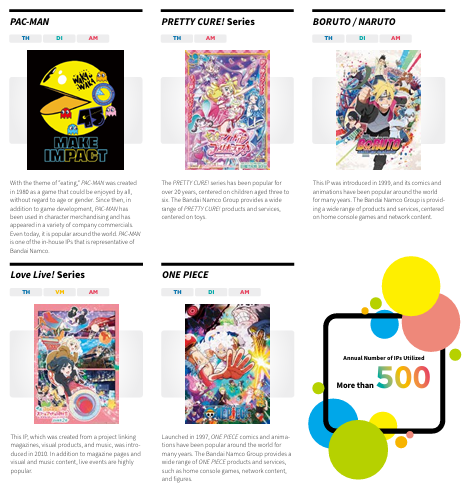
    Bandai Namco’s positioning is particularly compelling due to its ability to leverage franchises across games, toys, amusement parks etc. By monetizing IP through multiple formats, the company builds an integrated ecosystem that extends the lifecycle and economic value of each franchise. This structure creates meaningful moats, as success depends not on a single hit product but on coordinated execution across several categories.

    The primary risk is competition, particularly from rights holders such as Shueisha, which has stated ambitions to capture more value from its own franchises. However, partners like Shueisha lack the operational capabilities required to replicate Bandai’s model independently, as publishing, game development, and large-scale product commercialization rely on distinct and non-transferable skill sets. While competition remains a structural feature of the entertainment industry, franchise-driven ecosystems provide durability in margins and customer engagement.

    Multiples

    Bandai Namco is currently trading at a P/E of 24.4, representing a 12.6% discount to its five-year historical average and a 10% discount to peers. This multiple does not reflect first-half results, which indicate a modest increase in earnings. Assuming a long-term earnings CAGR of 10–14%, the implied annual return ranges from 12.7% to 20.2%, based on a 10% discount rate and an exit multiple of 24 under a continuous growth assumption. Over the past ten years, Bandai has delivered a CAGR of approximately 14%

    From a balance sheet and profitability perspective, Bandai Namco maintains low leverage and strong margins, broadly in line with peers.

    Bandai multiples:

    Liabilities/Assets28,01%
    Income/Liabilities42%
    Income/Revenue10,39%
    Income/Assets11,70%
    Income/Non Current Assets32,41%

    Notable mentions:

    • Kadokawa may increasingly pursue in-house game publishing rather than relying on Bandai Namco, which could reduce Bandai’s access to third-party IP over time.
    • A significant share of Bandai Namco’s IP exposure is tied to the anime segment, making parts of its growth dependent on continued demand within this category.
    • The current P/E multiple is partially influenced by the exceptional success of Elden Ring; as expectations normalize and release-related hype fades, reported growth and valuation metrics may compress.
    • The japanese yen (as illustrated vs the euro beneath).

    What MultipleStrategy thinks

    While Bandai Namco currently trades at an attractive valuation with strong profitability, structural risks to its Digital Business are emerging. The company relies heavily on licensing major IPs from media giants like Shueisha and Kadokawa—partners increasingly signaling intent to capture more value in-house.

    Signs of this shift are already visible. Kadokawa’s subsidiary, FromSoftware, recently reclaimed sole trademark rights for Elden Ring, indicating potential self-publishing of future blockbusters. Shueisha has launched Shueisha Games to develop indie titles internally, potentially still leaving room for Bandai Namco’s AAA studios.

    If these IP holders increasingly bypass Bandai Namco, the Gaming segment—responsible for a substantial portion of high-margin revenue—faces significant pressure. In contrast, the Toys & Hobby division remains protected by a moat of manufacturing and branding competencies, insulating it from similar disruption.

    In short, Bandai Namco remains a solid investment if it can maintain market share in its Digital Business, assuming continued global adoption of anime.

    ***Should mention:
    Bandai Namco owns Tekken & Gundam.
    – An older but relevant table illustrating margins and market caps across peers:

    Note: Square Enix is affected by one time effects.

  • Can Match Group Revive the Online Dating Market?

    Can Match Group Revive the Online Dating Market?

    Updated version: https://multiplestrategy.com/2026/04/22/match-group-update/

    Ticker: MTCH. Not financial advice.

    Match Group has negative equity, and half of their assets consist of goodwill. Their MAU (Monthly Active Users) has been declining since 2022. Furthermore, Match Group acquired HyperConnect in 2021 at what appears to be an overly optimistic price, leading to massive write-downs.

    Match Group recently changed their CEO (among other leadership changes), and as he stated during the Q2 earnings call: “Tinder needs a lot of work. It has grown stale because of short term monetization & lack of innovation.” Additionally, there is a general slowdown in the online dating market, and indications suggest Bumble has captured market share from them – along with other and more niche dating apps.

    On the other hand, Match Group has a reasonably profitable business, with an adjusted income / non-current assets ratio of 19% and an adjusted earnings / revenue margin of 17%. Furthermore, the new CEO intends to focus on making the company more agile, partly by laying off 20% of managers and reducing team sizes; he also plans to increase focus on product development. Established dating companies like Tinder and Bumble benefit from strong network effects.

    Even with Match Group’s negative equity and high proportion of goodwill, they are executing significant share buybacks amounting up to 130% of adjusted earnings. This can be explained by a ( long-term debt / interest expense ) of 2.4% and an adjusted earnings yield of 6.9%—in other words, low interest expenses and a low valuation (earnings per share relative to share price). This indicates a shareholder-friendly and aggressive capital allocation strategy that also suggests management believes the company is attractively priced.

    But – Match Groups debt ratio is simply too high, to justifying big share buybacks. While aggressive capital allocation is appreciated, the overall health of the company should come first. This is especially true since Match Groups refinancing could be coming in at higher interest rates. Furthermore stagnating revenue increases business risk which further increases cost of capital.

    I assume – The online dating market will continue to grow in the long term, following a normalization in MAU after a period of rapid expansion.

    Conclusion

    Match Group represents a high-risk turnaround case. While the company benefits from significant scale, network effects, and valuable user data, it faces major headwinds from elevated leverage, refinancing risks, and uncertainty regarding both execution and market development. Although the current valuation reflects many of these concerns, long-term success depends entirely on management’s ability to restore earnings growth and improve the value perceived by customers.

    Notable mentions:

    – User sentiment across the industry is historically poor, driven by a persistent perception that dating apps profit from keeping users single. The new CEO has signaled a strategic shift toward brand health, stating, “I would take a positive word of mouth over a $15 subscription any day.” This marks a critical potential pivot from short-term extraction to long-term value.

    – Interest expenses decreased in 2025, due to refinancing at a lower but stable interest. Decreasing the overall refinancing risk. Interest expenses should be higher in 2026, as there was a longer period in 2025 between paying off loans and settling new loans (Q3 2025). And liabilities/assets increased.

    – Match Group’s declining MAU stems from the Evergreen segment and Tinder, whereas Hinge is experiencing impressive growth.

    – Match Group has a adjusted earnings / (liabilities + goodwill) ratio of 8%.