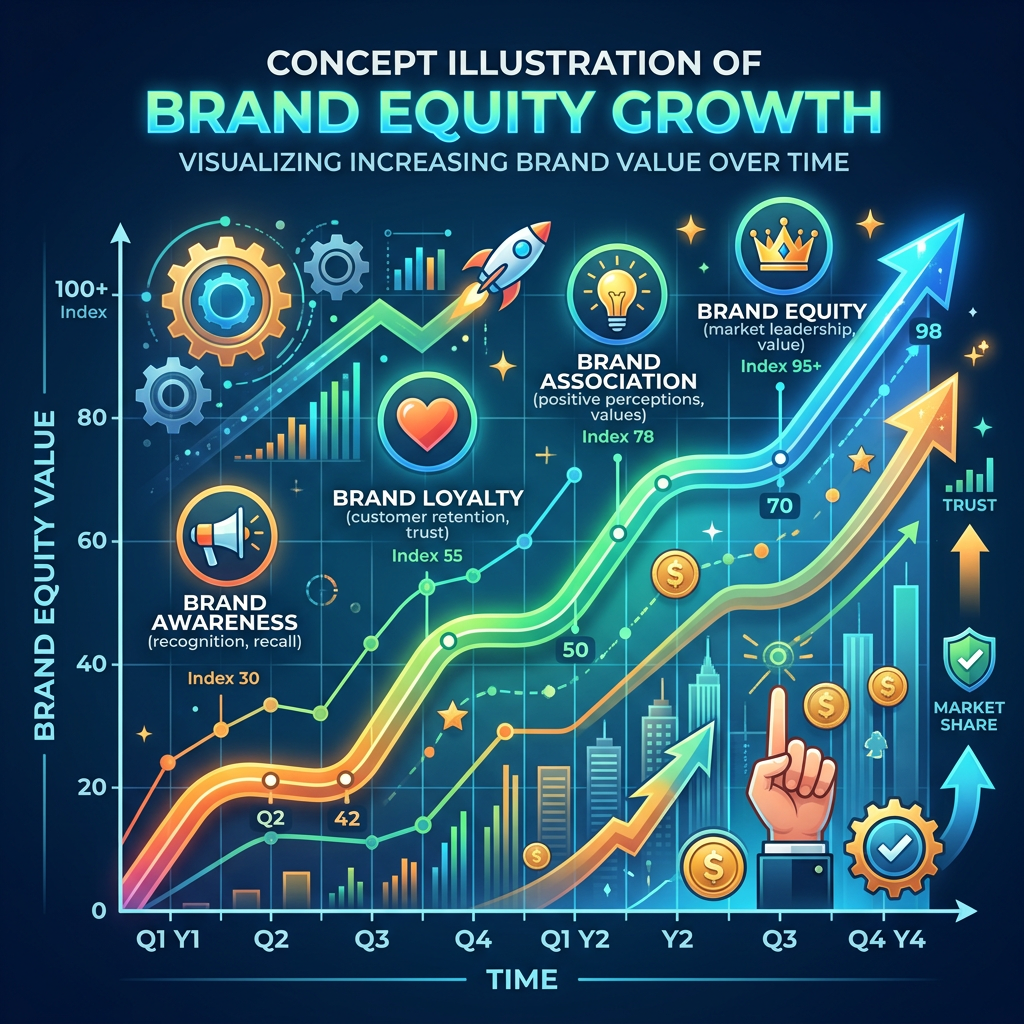
Every brand strategy has one clear goal: generate profitable growth and sustainable cash flow. However, marketing science is split on how to achieve this. One side focuses on building consumer perceptions (what people think and feel). The other relies on the hard data of buyer behavior (what people actually do). A strong strategy requires evaluating both: balancing how a brand builds perceived value against the mathematical reality of how markets actually grow.
Here is a direct breakdown of the core literature, analyzing the cause-and-effect pathways and the empirical limits of brand growth.
Segment 1: How Value is Created (Keller & Swaminathan, 2020)
Goal: Map the exact cause-and-effect chain from marketing spend to financial return. Key Points:
- The Brand Value Chain: Value creation happens in four distinct stages. The firm makes a marketing investment, which changes the customer mindset, which improves market performance (pricing power, market share), which ultimately increases shareholder value.
- The Multipliers: Moving from one stage to the next is not guaranteed. It is restricted by external multipliers: the actual quality of the campaign, competitor reactions in the market, and investor dynamics.
- Investment is Not Enough: Spending money is necessary but not sufficient to create value. Because external multipliers often sit outside the marketer’s control, campaigns must be critically evaluated for their actual financial impact, not just their creative execution.
Segment 2: Digital Measurement (France et al., 2025)
Goal: Update traditional brand tracking with high-speed digital metrics. Key Points:
- Speed of Data: Traditional surveys and financial audits are slow. Digital metrics like Share of Search, Digital Brand Awareness, and Digital Sentiment give managers real-time feedback.
- Share of Search: The percentage of Google searches a brand captures compared to its competitors is a strong, early indicator of future market share and sales.
- Data vs. Reality: While tracking online sentiment (likes, shares, comments) provides fast data, it must be critically analyzed. Online noise does not always translate directly to actual offline sales or expected financial value.
Segment 3: The Rules of Growth (Sharp, 2010)
Goal: Define the mathematical boundaries of brand growth using actual purchase data. Key Points:
- The Double Jeopardy Law: Sales data across categories consistently shows that brands grow by getting more buyers, not by getting existing buyers to buy significantly more often. Small brands suffer twice: they have fewer buyers, and those few buyers purchase less frequently.
- The Loyalty Myth: The idea that niche brands survive on small, highly loyal customer bases is empirically false. Loyalty levels remain largely the same across competing brands.
- The Heavy Buyer Trap: Spending marketing budgets primarily to reward or cross-sell to your heaviest buyers yields a low expected return. This strategy makes the mistake of confusing past behavior with future growth potential.
Segment 4: Finding Real Growth Potential (Trinh, Dawes, & Sharp, 2024)
Goal: Identify exactly which consumers offer the highest expected value for sales growth. Key Points:
- Measuring Headroom: Growth potential is found by looking at the “headroom”—how many category purchases a consumer makes without choosing your brand.
- Maxed-Out Heavy Buyers: Heavy buyers offer almost no future expected value. They already buy your brand as much as they need to; they physically cannot consume much more of it.
- Focus on the Masses: The highest expected return always comes from expanding reach. For small brands, up to 85% of growth potential lies with people who currently do not buy the brand at all. Even for massive market leaders, light buyers offer vastly more growth opportunity than heavy buyers.
Effective brand management is fundamentally an exercise in resource allocation and expected value. While Keller’s models show how to build the brand awareness and associations needed to justify higher prices, this effort must be strictly guided by the empirical rules set by Sharp and Trinh. To maximize financial returns, strategies must avoid the trap of targeting a saturated base of heavy buyers, and instead relentlessly focus on expanding reach among light and non-buyers.
Made in collaboration with Gemini 3.0